

The Dokimazō Filter: Approving What Is Excellent
Most leaders don't struggle because they're unfocused. They struggle because they're surrounded by legitimate, important things all competing for finite capacity. The Dokimazō Filter gives you three honest questions to cut through the noise and approve what is actually excellent in this season.

I heard something recently that I couldn't shake.
Kevin O'Leary was talking about Steve Jobs — specifically about how Jobs approached his time. Ruthlessly, intentionally, systematically. Every day he identified the three to five things that would actually move the needle. Everything else was noise. He ignored it without apology.
And honestly? Part of me respected it.
But then I sat with it a little longer.
Because Steve Jobs also died largely estranged from the people closest to him. A complicated relationship with his daughter. Friendships sacrificed on the altar of output. A legacy that is simultaneously one of the most impressive in modern business history — and a cautionary tale about what happens when prioritization is divorced from wisdom about what actually matters.
Ruthless focus is a tool. But a tool without wisdom about what deserves your focus can build an empire and empty a life at the same time.
That's the harder leadership question. Not just — how do I prioritize?
But — how do I know what's actually worth prioritizing?
Most leaders aren't struggling because they're lazy or unfocused. They're struggling because they're surrounded by legitimate, important things competing for finite capacity. Your team. Your family. Your responsibilities. Your growth. Your health. Your calling.
None of those are bad options. That's exactly what makes it hard.
Greg McKeown put it simply: "If you don't prioritize your life, someone else will."
The danger isn't always distraction. Sometimes the danger is letting the loudest thing — or the most visible thing — determine what gets your best.
Paul understood this tension. Writing to a church he loved — from a prison cell, no less — this is what he prayed over them:
"And it is my prayer that your love may abound more and more, with knowledge and all discernment, so that you may approve what is excellent."
— Philippians 1:9-10 (ESV)
Approve what is excellent.
The Greek word behind approve is dokimazō — a refiner's term. It described the process of testing metal to determine its genuine worth. Not just identifying what's good. Examining what's genuinely excellent — worthy of this season, this capacity, this moment.
Discernment isn't instinct. It's a developed capacity. And it's worth praying for.
So how do you actually do it? How do you stand in the middle of a full life — full calendar, full inbox, full responsibility — with five legitimate things pulling at you simultaneously, and actually decipher what's important and what's just noise?
It's not a clean process. There's no spreadsheet that does this for you. Discernment happens in the tension, not around it. But there are questions worth asking that cut through the noise — not perfectly, but honestly. And honest examination is where clarity usually begins.
Three questions worth sitting with:
What cannot move without real consequence?
Some things, if neglected, don't just pause — they break. These are load-bearing. They don't get set down.
What is important but can survive an intentional pause?
Not everything significant is immediately urgent. Some things are genuinely valuable but seasonally flexible. The operative word is intentional — there's a difference between setting something down with care and just letting it fall.
What am I treating as urgent that isn't actually excellent?
This is the hardest one. Some things feel pressing because they're loud — not because they're worthy. The dokimazōquestion is honest: does this actually hold up under examination? Is it excellent — or just noisy?
Jobs prioritized brilliantly. But the filter he used was almost exclusively output. What will move the product forward. What will change the industry.
The filter Paul prays for is different. It accounts for the whole life — love, relationships, legacy that outlasts a product cycle. It asks not just what moves the needle but what is genuinely excellent when you examine it honestly.
That's the leader worth becoming. Not just ruthlessly focused — but wisely discerning.
Knowing what season you're in. Knowing what's load-bearing. Approving what is actually excellent — and having the clarity and courage to let the rest wait.
Start Strong. Lead Well.
Load-Bearing Leadership: Set Down. Not Abandoned.
Leaders are rarely choosing between what's important and what isn't. We're almost always choosing between multiple important things with limited capacity. This is a reflection on what it means to lead well in a demanding season — and the difference between setting something down and walking away from it.
There's a leadership lesson I didn't plan to learn this year.
I learned it by living it.
For the last several months, I went quiet here. No posts. No reflections. No weekly leadership nuggets showing up in your feed on Monday mornings. And if you noticed — thank you. That actually means something.
Here's what was really happening.
My full-time role demanded everything I had. I was leading a multimillion dollar technology transformation that didn't have margin for distraction. My family needed me present — my boys, my wife Sara, and aging parents who deserved my attention. And somewhere in the middle of all of that, Start Strong | Lead Well had to be set down.
Not abandoned. Set down.
There's a difference — and I think it's one of the most underrated leadership distinctions there is.
Patrick Lencioni once said: "If everything is important, then nothing is."
Leaders are rarely choosing between what's important and what isn't. That would be easy. We're almost always choosing between multiple important things with limited capacity. And the ones who lead well over time aren't the ones who somehow do it all. They're the ones who know what season they're in — and steward their capacity accordingly.
"There is a time for everything, and a season for every activity under the heavens." — Ecclesiastes 3:1
Not everything important requires your attention at the same time.
Some things are load-bearing in this season. They cannot be set down without real consequence. Your family. Your primary responsibilities. The people counting on you today.
Other things are important but can survive a pause — if you set them down intentionally rather than just letting them fall.
The key word is intentionally.
I didn't drift away from this. I made a quiet decision to protect what was load-bearing and trust that what mattered would still be here when the season shifted.
It is. And I am.
What I didn't share publicly is that while I was away from posting, I wasn't away from Start Strong | Lead Well. I spent that season building something behind the scenes — developing an executive coaching framework, refining a coaching philosophy, and creating the tools and structure to help leaders do exactly what I just described. Navigate pressure. Protect what matters. Lead with clarity in demanding seasons.
More on that soon.
But for today — just this:
What season are you in right now? What's load-bearing that deserves your full attention? And what important thing might need to be set down — intentionally — so you can carry what actually matters right now?
Faithfulness doesn't always look like output. Sometimes it looks like tending to what's right in front of you and trusting the rest to wait.
Start Strong. Lead Well.
— Joshua
Leadership Conditioning
A men’s basketball night with my son turned into an unexpected leadership lesson. When I jumped into two hours of full-court basketball without conditioning, my knees paid the price. Leadership works the same way — the pressure of the moment often reveals the preparation we skipped. A reflection on why the quiet disciplines leaders practice before the pressure comes matter more than the visible moments.
What basketball, sore knees, and leadership all have in common

A couple of weeks ago, I learned a leadership lesson the hard way.
On a basketball court.
Our church hosted a men’s basketball night, and I brought my 13-year-old son because he loves to play. I was expecting a handful of guys my age casually shooting around. Instead, while my son did end up being the youngest guy in the gym… I, on the other hand… I was the second-oldest.
Everyone else? Young. Lean. In shape. In their prime.
And to make things even better, someone decided we should play full court.
What I thought would be light hoops turned into four games of full-speed, physical basketball over two hours. No stretching. No warm-up. No conditioning. Just pride and adrenaline. And if you know me, you know, the only way I was bowing out or quitting was if they had to carry me out on a stretcher.
And here’s the thing: I knew better.
Somewhere between icing my knees and rethinking my life choices, it hit me: leadership works the same way.
You don’t usually get injured because you forgot to stretch that day. Stretching helps on game day. Hydration helps on game day. Warm-ups help you loosen up before the action starts.
But real conditioning doesn’t happen the day of the game.
Strength conditioning, dropping weight, building endurance, and training your body for intensity happen well before you ever step onto the court. Those are regular-life disciplines — the unglamorous things you do when there’s no crowd, no scoreboard, and no adrenaline.
And if you don’t build that kind of conditioning, game day will reveal it fast.
The court didn’t create the problem.
It revealed it.
Nobody applauds conditioning. Nobody celebrates stretching, hydration, and warm-ups. Nobody posts about the boring disciplines that prepare you for a hard season.
Leadership conditioning isn’t glamorous either.
No one gets excited about a clear Statement of Work. No one brags about a detailed project plan. No one high-fives you for clarifying roles or running team training before launch.
But once the project starts… once the season begins… once the pressure rises… those quiet disciplines are what protect you.
If you don’t condition beforehand, intensity becomes injury.
Here are four leadership conditioning habits that apply anywhere:
1. Clarify the why before the work.
If the mission isn’t clear, effort gets misdirected. Confusion multiplies under pressure.
2. Define roles before the run.
If ownership isn’t clear, friction is inevitable. Alignment beats assumption every time.
3. Set expectations before stress.
What feels obvious in calm moments becomes chaos under pressure.
4. Pace yourself before the push.
Endurance doesn’t show up automatically. It’s built slowly, before the sprint.
Hebrews 12:11 puts it this way: “For the moment all discipline seems painful rather than pleasant, but later it yields the peaceful fruit of righteousness to those who have been trained by it.” (ESV)
Trained by it. Conditioned by it.
The discipline isn’t flashy. It’s preventative.
This week reminded me of something simple:
Just because I can jump into full-court leadership doesn’t mean I should without conditioning first.
The quiet disciplines matter more than the visible moments.
So here’s the question I’m asking myself this week:
Where am I stepping into intensity without the conditioning to sustain it?
Because conditioning may not be glamorous…
…but it sure beats limping through the season.
Start Strong, Lead Well
- Joshua
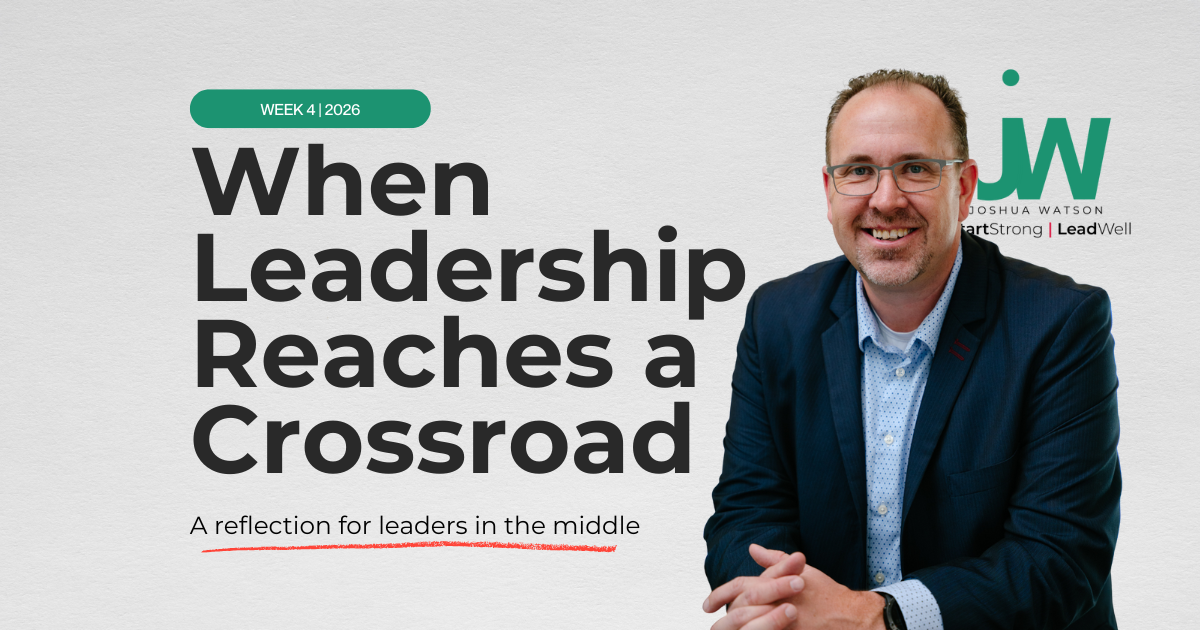
When Leadership Reaches a Crossroad: A reflection for leaders in the middle
Leadership doesn’t always break down in crisis. Sometimes it slows down in quiet questions you can’t ignore anymore. A reflection for leaders navigating the tension between faithfulness, consistency, and calling.
I love leadership — because I love helping leaders.
Not the spotlight version of leadership. Not the polished, platform-driven kind. I love leadership because I love seeing people thrive. I love helping leaders carry responsibility with clarity, courage, and faithfulness — especially when no one is applauding.
That desire didn’t start with a brand or a content plan. Start Strong | Lead Well wasn’t something I set out to “build.” It emerged naturally from who I am and how I’m wired. I’ve learned something about myself over time: if I’m not positioned to help others, I’m not fulfilled. My purpose is tied to seeing people grow — spiritually, emotionally, relationally, and as leaders.
My life motto reflects that: So Others May Live.
That’s the heart behind this space.
How This Started (and Why I’m Reflecting Now)
By most standards, Start Strong | Lead Well is still very new. I began sharing these weekly reflections last year — not as a finished product, but as an offering. An experiment. A discipline of reflection meant to help leaders begin their week grounded and lead it well.
And because it’s new — and still emerging — this feels like the right time to pause and reflect.
That’s something leaders should do, especially early in a journey.
Reflection isn’t hesitation.
Re-examination isn’t weakness.
Sometimes it’s wisdom.
The Quiet Questions That Don’t Go Away
Leadership doesn’t always break down in crisis. Sometimes it slows down in quiet questions you can’t ignore anymore.
There comes a point when continuing the same way starts to feel less faithful than re-examining why you began in the first place.
This isn’t burnout.
It isn’t quitting.
It isn’t a lack of discipline.
It’s leadership pausing long enough to tell the truth.
The Question Beneath the Questions
If I’m honest, there’s a deeper question underneath all of this — one I’ve wrestled with privately for a while:
Am I helping leaders merely consume encouragement… or helping them carry leadership differently?
There are countless leadership voices online. Many are sharper, louder, more prolific, or more established. If Start Strong | Lead Well were to stop tomorrow, the internet wouldn’t notice. The algorithm would move on. Content would keep flowing.
And that realization isn’t discouraging — it’s clarifying.
Because this space was never meant to chase attention. It was meant to serve leaders.
Leading From the Middle
I deeply respect leaders who shape thinking through books and platforms. Their work matters. Their influence has shaped me, and I’m grateful for the mentorship they provide from a distance through their words and teaching.
But most of my leadership life hasn’t been lived on stages.
It’s been lived in the middle.
No bravado.
No gloss or glamour.
No spotlight.
Just responsibility. Day after day.
Reporting up. Caring down. Managing pressure. Solving problems. Navigating tension. Showing up for a team. Being present for a family. Answering to a boss. Carrying weight quietly.
And I believe there are leaders who need reflections from that place too — from the middle, where leadership is lived more than it is explained.
Not the Many — the One
Leadership isn’t always about reaching the many.
Sometimes it’s about being faithful to the one who needs encouragement right now.
That idea is deeply rooted in my faith. Jesus spoke about leaving the ninety-nine to go after the one — not because the many didn’t matter, but because the one did.
That’s something I’m realizing more clearly about Start Strong | Lead Well.
I’m not trying to go viral.
I’m not chasing scale.
I’m not building for clicks, likes, or applause.
I’m writing for the one leader who’s tired but still faithful.
For the one who feels the tension but keeps showing up.
For the one who needs clarity, not noise.
If that’s a small group, that’s okay.
Faithfulness has never required an audience.
Why I’m Sharing This
I’m not writing this to resolve the tension — but to name it honestly.
Because leaders everywhere are navigating similar crossroads. Deciding whether to continue, adjust, refine, or release. Wondering whether consistency is still aligned with calling. Asking whether what they’re building is truly serving others.
These are good questions.
And leaders don’t need more answers shouted at them. They need space to reflect.
That’s what this post is — and what I hope Start Strong | Lead Well continues to be: a quiet place for leaders in the middle to think clearly, lead faithfully, and remember why they began.
If this tension feels familiar, you’re not alone.
And you’re welcome here.
12 Leadership Decisions That Will Shape Your Year
Strong leaders don’t drift into good years — they decide their way into them. Leadership isn’t shaped by bold resolutions, but by quiet, consistent decisions about what we protect, prioritize, and practice. These twelve leadership decisions will help you step into 2026 with clarity, intention, and purpose.

Strong leaders don’t drift into good years.
They decide — early — how they’ll lead.
Over time, I’ve noticed that leaders who experience clarity, health, and sustained influence don’t rely on motivation or momentum. They make intentional decisions before the year begins to move too fast.
Not resolutions.
Not goals.
Decisions.
John Maxwell puts it simply: “Life is a matter of choices, and every choice you make makes you.” Leadership formation works the same way. Over time, our decisions shape our character, our influence, and the environments we lead.
Scripture reminds us that intentional leadership isn’t about control — it’s about alignment:
“The heart of man plans his way, but the LORD establishes his steps.”
— Proverbs 16:9 (ESV)
Here are 12 leadership decisions that quietly shape the year ahead.
1. Decide What You Will Protect
Time, energy, health, and relationships don’t protect themselves. Without clear boundaries, leadership demands will slowly erode what matters most. Deciding what you will protect early in the year creates margin that sustains you when pressure increases.
2. Decide How Your Calendar Will Reflect Your Priorities
Your calendar reveals your real values, not your stated ones. Strong leaders don’t just react to requests — they intentionally schedule what matters most. When your priorities live on your calendar, they stop competing with everything else.
3. Decide How You Will Communicate Expectations
Many leadership frustrations aren’t people problems — they’re clarity problems. Deciding how and when you’ll communicate expectations reduces confusion and builds trust. Clear expectations give people confidence in how to win.
4. Decide How You Will Develop People
Leadership that lasts multiplies. Growth doesn’t happen accidentally — it happens through intentional coaching, feedback, and opportunity. Deciding who you’ll invest in ensures your leadership impact extends beyond your own capacity.
5. Decide What You Will Say “No” To
Focus requires restraint. Every “yes” carries a cost, whether you see it immediately or not. Deciding ahead of time what doesn’t belong in your year helps you preserve energy for what does.
6. Decide How You Will Handle Pressure
Pressure is inevitable in leadership, but panic is optional. Deciding in advance how you’ll respond under stress keeps emotions from driving decisions. Prepared leaders respond thoughtfully instead of reacting impulsively.
7. Decide How You Will Care for Your Health
Leadership is demanding, and neglect eventually shows up somewhere. Physical, emotional, and spiritual health directly affect how you show up for others. Deciding to care for your health isn’t selfish — it’s responsible leadership.
8. Decide How You Will Build Trust
Trust grows through consistency, integrity, and follow-through. Small, repeated actions shape credibility far more than big moments. Deciding to be dependable in both visible and unseen ways builds a foundation others can rely on.
9. Decide How You Will Course-Correct
Strong leaders don’t avoid adjustment — they expect it. Deciding now that feedback and correction are part of growth keeps pride from blocking progress. Course-correction is not failure; it’s leadership maturity.
10. Decide How You Will Finish the Year
Strong finishes don’t happen by accident. Deciding early how you want to close the year influences how you pace yourself throughout it. Leaders who finish well build momentum that carries forward.
11. Decide How You Will Measure Success
Busyness is not success, and visibility isn’t impact. Deciding what “winning” actually means protects you from chasing the wrong metrics. Clear measures of success bring focus and reduce unnecessary pressure.
12. Decide What You Will Carry Forward
Every year leaves something behind — habits, lessons, and patterns. Deciding intentionally what you’ll carry forward helps you build on growth instead of repeating mistakes. Reflection turns experience into wisdom.
Final Thought
You don’t need a perfect plan for the year ahead.
You need clarity.
Strong leadership starts with intentional decisions — and those decisions quietly shape everything that follows.
Start Strong. Lead Well.

Leadership Begins at Home: Why Presence Shapes Everything You Lead
Your leadership at home becomes the emotional foundation you lead from everywhere else. Strengthen the rhythms inside your home, and you strengthen every other part of your leadership.

There’s a leadership truth I’ve come to appreciate more deeply with every season of life:
Your leadership at home shapes your leadership everywhere else.
Home is the place where your values are lived, not just stated.
It’s where trust is formed, where emotional stability is either reinforced or eroded, and where the people closest to you experience the truest version of your leadership.
Home is the foundation you lead from.
At the center of that foundation is presence — not proximity, not perfection, but intentional presence.
Presence that adapts as seasons change, but never disappears.
This past year brought new rhythms into our home. Our oldest stepped into adulthood, and presence began to take a new shape. It became shared Bible studies through an app, encouraging messages, and phone calls across the distance.
At the same time, this season opened space for deeper connection with our younger son and more intentional support for my spouse.
Different rhythms.
Same calling.
Be present for the people who matter most.
Scripture captures this truth with quiet strength:
“In the fear of the Lord one has strong confidence,
and his children will have a refuge.”
— Proverbs 14:26 (ESV)
That word refuge matters.
A refuge is not built in moments of intensity.
It’s built through stability.
Through consistency.
Through leadership that can be felt, not just heard.
This is where leadership at home becomes leadership everywhere else.
Patrick Lencioni says it well:
“Great teams are built on trust. So are great families.”
Trust doesn’t come from grand gestures or perfectly executed plans.
It grows through everyday choices — the tone you set, the attention you give, and the rhythms you create.
As we look toward 2026, here are three practices that help leaders strengthen their leadership at home — and, by extension, every other place they lead.
1. Be Present
Presence is your most powerful form of influence.
Not because you are always physically nearby, but because when you are present, you are engaged. Listening. Paying attention. Not distracted.
Presence communicates value.
At home, people don’t need flawless leadership.
They need leadership that shows up — consistently and intentionally.
Presence looks different in every season.
Sometimes it’s time around the table.
Sometimes it’s a conversation before bed.
Sometimes it’s a message sent across the distance just to say, “I’m thinking about you.”
What matters most isn’t the format.
It’s the intentionality behind it.
2. Create Rhythms
Strong families aren’t built on intensity.
They’re built on rhythms.
Small, repeatable moments that anchor connection.
Rhythms reduce uncertainty.
They create predictability, safety, and shared expectation.
A weekly meal.
A standing conversation.
A consistent check-in.
A shared practice.
These moments don’t need to be elaborate. In fact, the simplest rhythms are often the most powerful because they’re sustainable.
Over time, rhythms do something remarkable:
they make connection feel normal — not forced.
And that sense of stability becomes the emotional foundation your leadership rests on everywhere else.
3. Speak Life
Words carry weight — especially at home.
Encouragement isn’t about hype or flattery.
It’s about naming what matters, affirming growth, and reinforcing identity.
When leaders speak life at home, they help build resilience.
They remind their family who they are — even when circumstances are changing.
Encouraging words don’t ignore challenges.
They help people face them with confidence.
And when encouragement is consistent, it becomes a quiet strength others carry with them long after the conversation ends.
As you prepare for 2026, remember this:
Your leadership at home is part of your leadership story.
When your home is strengthened, your leadership everywhere else is steadied.
This week’s Study Guide is designed to help you:
reflect on your current rhythms
strengthen intentional presence
and begin shaping patterns that will carry into the year ahead
👉 Download the Week 3 Study Guide and continue building your 2026 Leadership Guidepost.

Thankfulness Isn’t Just a Gesture — It’s a Force Multiplier
Thankfulness isn’t just polite — it’s powerful. When leaders practice gratitude with intention, they strengthen culture, deepen trust, and empower teams to thrive. This week’s reflection explores how gratitude becomes a force multiplier and offers three practical ways to put it into action.
Week 47 | StartStrong | LeadWell
Thanksgiving has a way of slowing us down long enough to notice what should have mattered all along. It’s a rare pause in the year — a moment when pace gives way to perspective and we’re reminded of something leaders often forget:
Thankfulness isn’t sentimental.
It’s strategic.
In leadership, the pull to produce never stops. There’s always a deadline, a fire, a meeting, a need. Pressure pushes teams to perform — and yes, urgency has its place. But urgency alone can’t build a healthy culture.
Gratitude can.
When leaders practice thankfulness with intention, something powerful happens: stability increases, trust deepens, and people begin to engage from the heart rather than obligation. Appreciation creates conditions where people want to grow, not just where they’re expected to.
Paul’s words in Colossians 3:15 (ESV) illuminate this beautifully:
“And let the peace of Christ rule in your hearts… And be thankful.”
He wasn’t writing about workplace pressure, but the principle still holds. Peace and gratitude go together — and together, they shape the environments we influence.
In a world that moves fast, gratitude slows us down long enough to see the people who move the mission forward.
So how do leaders cultivate gratitude in a meaningful way? Here are three practical, relationally rich practices that cost nothing but intention — and return more than you imagine.
1. Be Specific
A vague “Great job!” rarely inspires.
But specific appreciation? That creates impact.
“Thanks for staying late” becomes:
“Thank you for staying late and keeping the project moving. Your attention to detail made the difference.”
People feel valued when they feel seen.
And when people feel seen, confidence rises — and culture strengthens.
2. Invite Voices
Asking for input is one of the simplest forms of gratitude.
It says far more than, “What do you think?”
It communicates:
“Your perspective matters. What you see matters. You matter.”
Leaders who listen well don’t just gather insight — they build trust.
And trust is the foundation of every strong team.
3. Stay Consistent
Gratitude shouldn't appear only during holidays, recognition days, or annual reviews.
It should show up in:
• quick messages
• hallway conversations
• unexpected acknowledgments
• small check-ins that communicate care
When gratitude becomes a rhythm, it becomes a culture.
Consistency turns appreciation from a moment into a movement.
Where Gratitude Leads Us
Gratitude doesn’t demand more time — it demands intention.
It asks leaders to slow down long enough to notice, appreciate, and affirm the people who make the mission possible.
This week, consider:
Where can you practice gratitude with more clarity?
And how might it strengthen the people you lead?
Because the truth is simple:
The more consistently you practice gratitude, the stronger your leadership becomes.

Thermostat Leadership: Steady Under Pressure
Leadership isn’t about avoiding pressure—it’s about leading through it with composure and faith. This reflection explores what it means to be a thermostat leader—steady, steadfast, and grounded in peace.
When Pressure Tests Your Leadership
Pressure has a way of revealing what’s really inside us.
Over the past few months, I’ve been leading through one of the most complex and high-stakes projects of my career. Plans shifted. Timelines moved. The outcome looked nothing like what we expected. And yet, in the middle of it all, I saw something powerful taking shape—grit, perseverance, and true leadership rising to the surface.
Those seasons have a way of humbling you. They strip away comfort, test your character, and force you to ask: What kind of leader am I under pressure?
Thermometers vs. Thermostats
Every leader faces a choice in moments like that.
We can be thermometers, simply reflecting the atmosphere around us, or thermostats, intentionally setting it.
A thermometer rises and falls with the environment.
A thermostat regulates the environment with consistency and composure.
The best leaders don’t react to the climate—they reset it.
They bring calm into chaos and confidence into uncertainty.
As author Brian Tracy once said:
“The true test of leadership is how well you function in a crisis.”
Pressure Doesn’t Just Reveal Character — It Refines It
I’ve learned that the true measure of leadership isn’t control—it’s composure.
Anyone can lead when things go right. But when the unexpected happens, leaders are called to steady others by first being steady within themselves.
Pressure doesn’t just reveal character—it refines it.
It shapes endurance. It deepens empathy. It reminds us that leadership is less about holding everything together and more about staying grounded in what matters most.
A Steadfast Spirit
James 1:12 puts it this way:
“Blessed is the man who remains steadfast under trial, for when he has stood the test he will receive the crown of life, which God has promised to those who love him.”
— James 1:12 (ESV)
James wasn’t writing about workplace stress or project deadlines—he was speaking about trials that test our faith. Yet the same steadfast spirit that anchors us in faith can also steady us in leadership.
When our confidence is grounded in God, not outcomes, we can lead with peace even when everything around us feels uncertain.
Lead with Composure
When pressure builds, I’ve learned to pause and ask myself:
Am I mirroring the chaos around me, or modeling the peace within me?
Leadership isn’t about control; it’s about composure.
When we choose to lead from that quiet center—rooted in faith, anchored in peace—we create stability for everyone around us.
Our teams don’t need us to have all the answers; they need us to carry peace into the room.
Set the Temperature
Leadership has never been about avoiding the heat; it’s about standing in it with the kind of faith and steadiness that changes the atmosphere.
Be the thermostat this week.
Set the tone.
Lead with clarity, faith, and steadfast presence.
Because when peace rules in you, it spreads through those you lead.
#StartStrongLeadWell

The Decision Filter: Leading with Wisdom and Peace
Leadership doesn’t always provide perfect clarity. This reflection unpacks how the Decision Filter—Values, Vision, and Voice—helps leaders seek wisdom, invite God’s perspective, and move forward in peace.
When Leadership Demands Discernment
Leadership rarely gives you perfect information.
More often, it gives you tension—two good options, one hard choice, and the weight of knowing people are depending on your decision.
I’ve been there. Early in my career, I used to pray for certainty—for God to spell it out clearly. But I’ve learned that leadership isn’t about finding certainty; it’s about walking in discernment.
Certainty demands control.
Discernment requires trust.
And that shift has changed the way I lead.
The Decision Filter
Over the years, I began using what I call The Decision Filter—a simple way to slow down and align choices with what matters most.
I run every significant decision through three questions:
1. Values — Does this line up with who I am and what I believe?
2. Vision — Does this move me toward where God is leading?
3. Voice — Have I invited wise counsel and God’s perspective into it?
It’s not a formula; it’s a framework.
The Decision Filter helps me lead from conviction, not emotion—rooted in truth rather than driven by pressure.
Wisdom for the Asking
James gives leaders a promise that’s both simple and profound:
“If any of you lacks wisdom, let him ask God, who gives generously to all without reproach, and it will be given him.”
— James 1:5 (ESV)
James was writing to believers facing trials, not executives facing deadlines, but the principle still holds: wisdom isn’t earned; it’s asked for.
Leaders don’t need to have every answer—they just need the humility to seek God’s.
Dr. Tony Evans once said,
“All decision-making is a values-clarifying exercise.”
He’s right. Every choice—big or small—reveals what’s really leading us.
When we pause to examine our motives through the Decision Filter, we discover what’s steering our hearts: fear or faith, ambition or obedience.
Peace as Confirmation
There’s one more layer to wise leadership: peace.
After I’ve walked through my filter, I pay attention to what’s happening in my spirit. When the peace of God settles deep in my heart—even if the situation still feels uncertain—that’s my signal I’m heading in the right direction.
“And the peace of God, which surpasses all understanding, will guard your hearts and your minds in Christ Jesus.”
— Philippians 4:7 (ESV)
That peace doesn’t guarantee an easy road; it simply assures me I’m not walking it alone.
It guards my heart, confirms my direction, and gives me confidence to step forward in faith.
Leading with Clarity and Conviction
Leadership decisions will always carry weight, but they don’t have to carry confusion.
When you filter your choices through Values, Vision, and Voice, ask for wisdom, and follow peace, you can move forward—even into uncertainty—with confidence.
Because godly leadership isn’t about controlling outcomes.
It’s about walking faithfully in the direction of wisdom and trusting God with the rest.
#StartStrongLeadWell

What’s Your Story? Leading Through Listening
Every person you lead has a story shaping how they work and why they care. This reflection explores how asking one simple question—“What’s your story?”—builds trust, deepens connection, and aligns hearts toward a shared purpose.
One of the most powerful questions a leader can ask is simple yet profound:
“What’s your story?”
Over the years, I’ve learned that question has the power to change relationships, reshape teams, and reveal the heart behind the work we do.
When we take time to listen, we do more than gather information—we build bridges. Every story we hear becomes a bridge we can lead across.
The Power of a Question
When I served as a pastor, I became known for asking that one question. Most of those conversations happened over coffee—just two people sitting down, one cup and one story at a time.
I discovered that when people share their stories, they open the door to their hearts. They share their dreams, fears, values, and faith. And often, what begins as small talk turns into sacred ground.
Jesus said it best:
“Out of the abundance of the heart his mouth speaks.”
— Luke 6:45 (ESV)
If we listen long enough, we begin to hear what fills a person’s heart. Their words reveal what matters most to them—their priorities, their pain, and their purpose.
Good leaders learn to listen that way—not just with their ears, but with discernment.
From the Church to the Marketplace
What I learned in ministry still shapes how I lead today.
Every person on your team has a story shaping how they work and why they care.
If you listen long enough, you’ll always find common ground—a shared value, a familiar struggle, or a common dream. It might take some digging, but it’s always worth the effort.
Listening turns workplaces into communities and coworkers into collaborators.
The Divine Intersection
I call this the Divine Intersection—the place where your story intersects with mine, and together they align with a greater mission and vision.
When stories connect, trust grows. Connection deepens. Collaboration strengthens.
Purpose becomes shared.
That’s the moment leadership becomes more than strategy—it becomes ministry.
Lead People, Not Tasks
Leadership at its best isn’t about directing tasks; it’s about developing people.
And people are shaped by their stories.
The moment you ask, “What’s your story?” you stop leading tasks and start leading hearts.
So, here’s the challenge for this week:
Who’s one person on your team whose story you need to hear?
Because every time we listen with intention, we lead with compassion.
And that’s where trust—and transformation—begin.
#StartStrongLeadWell