
Leadership Conditioning
A men’s basketball night with my son turned into an unexpected leadership lesson. When I jumped into two hours of full-court basketball without conditioning, my knees paid the price. Leadership works the same way — the pressure of the moment often reveals the preparation we skipped. A reflection on why the quiet disciplines leaders practice before the pressure comes matter more than the visible moments.
What basketball, sore knees, and leadership all have in common

A couple of weeks ago, I learned a leadership lesson the hard way.
On a basketball court.
Our church hosted a men’s basketball night, and I brought my 13-year-old son because he loves to play. I was expecting a handful of guys my age casually shooting around. Instead, while my son did end up being the youngest guy in the gym… I, on the other hand… I was the second-oldest.
Everyone else? Young. Lean. In shape. In their prime.
And to make things even better, someone decided we should play full court.
What I thought would be light hoops turned into four games of full-speed, physical basketball over two hours. No stretching. No warm-up. No conditioning. Just pride and adrenaline. And if you know me, you know, the only way I was bowing out or quitting was if they had to carry me out on a stretcher.
And here’s the thing: I knew better.
Somewhere between icing my knees and rethinking my life choices, it hit me: leadership works the same way.
You don’t usually get injured because you forgot to stretch that day. Stretching helps on game day. Hydration helps on game day. Warm-ups help you loosen up before the action starts.
But real conditioning doesn’t happen the day of the game.
Strength conditioning, dropping weight, building endurance, and training your body for intensity happen well before you ever step onto the court. Those are regular-life disciplines — the unglamorous things you do when there’s no crowd, no scoreboard, and no adrenaline.
And if you don’t build that kind of conditioning, game day will reveal it fast.
The court didn’t create the problem.
It revealed it.
Nobody applauds conditioning. Nobody celebrates stretching, hydration, and warm-ups. Nobody posts about the boring disciplines that prepare you for a hard season.
Leadership conditioning isn’t glamorous either.
No one gets excited about a clear Statement of Work. No one brags about a detailed project plan. No one high-fives you for clarifying roles or running team training before launch.
But once the project starts… once the season begins… once the pressure rises… those quiet disciplines are what protect you.
If you don’t condition beforehand, intensity becomes injury.
Here are four leadership conditioning habits that apply anywhere:
1. Clarify the why before the work.
If the mission isn’t clear, effort gets misdirected. Confusion multiplies under pressure.
2. Define roles before the run.
If ownership isn’t clear, friction is inevitable. Alignment beats assumption every time.
3. Set expectations before stress.
What feels obvious in calm moments becomes chaos under pressure.
4. Pace yourself before the push.
Endurance doesn’t show up automatically. It’s built slowly, before the sprint.
Hebrews 12:11 puts it this way: “For the moment all discipline seems painful rather than pleasant, but later it yields the peaceful fruit of righteousness to those who have been trained by it.” (ESV)
Trained by it. Conditioned by it.
The discipline isn’t flashy. It’s preventative.
This week reminded me of something simple:
Just because I can jump into full-court leadership doesn’t mean I should without conditioning first.
The quiet disciplines matter more than the visible moments.
So here’s the question I’m asking myself this week:
Where am I stepping into intensity without the conditioning to sustain it?
Because conditioning may not be glamorous…
…but it sure beats limping through the season.
Start Strong, Lead Well
- Joshua
IDENTITY BEFORE INFLUENCE
When identity is unclear, leaders manage perception instead of responsibility. Courage comes first—then clarity. This lesson applies anywhere you lead.
A reflection on leadership, approval, and learning to lead from the right place
There was a season early in my leadership journey when I lost myself.
At the time, I didn’t realize that’s what was happening. I would’ve told you I was just trying to learn, grow, and find my footing. But looking back, I can see it more clearly now.
It happened early in my tenure as a senior pastor, shortly after we planted our church. I was longing for acceptance and assurance from my peers — leaders I respected, leaders I wanted to learn from, leaders I hoped would see something in me.
It didn’t come easily.
More often than not, I found myself on the outside looking in. Hoping to be included, but not invited. Invited, but feeling like the fifth wheel once I arrived. Always aware of where I stood — or where I thought I stood — in the room.
And slowly, almost imperceptibly, something shifted.
I began striving to be who I thought everyone else wanted me to be. I adjusted my tone. I second-guessed my instincts. I tried to fit into molds that weren’t mine to carry. In the process, I lost sight of my purpose and who God had actually called me to be.
It was painful.
But it was also formative.
Because that season taught me a leadership lesson I’ve carried ever since: when approval becomes the focus, identity quietly erodes.
When Attention Is Misplaced
What I didn’t realize at the time was that my attention was aimed at the wrong target.
I wasn’t driven by arrogance or ego. I was driven by insecurity — by a need to be liked, to belong, to feel validated in the space I had been called to lead.
And when that becomes the driver, leadership suffers.
When identity is unclear, leaders begin managing perception instead of responsibility. Clarity gets softened. Hard conversations get delayed. Decisions get filtered through how they might be received rather than whether they’re right.
Leadership becomes exhausting — not because the work is too hard, but because it’s being carried from the wrong place.
That lesson isn’t unique to ministry.
The context for me happened to be pastoral leadership, but the dynamic shows up everywhere — in boardrooms, project teams, startups, and organizations of every kind. Wherever leaders feel pressure to prove they belong, the same temptation exists: to lead for approval rather than from conviction.
A Needed Reorientation
I’m grateful for that season now, as uncomfortable as it was, because it eventually forced a shift.
At some point, I realized I couldn’t keep chasing acceptance without losing myself entirely. So I stopped trying to appease the masses and refocused my energy on doing what I knew I was called to do — faithfully, consistently, and to the best of my ability.
When that shift happened, things began to change.
My decision-making became clearer.
My leadership became more courageous.
My consistency improved.
Not because I suddenly became fearless — but because I was no longer trying to impress people to earn a seat at a table. I stopped mimicking and started leading. I stopped trying to force myself into spaces that required me to be someone else.
Identity realigned.
Leadership followed.
Scripture Brings the Question Into Focus
The apostle Paul names this tension with striking clarity in his letter to the Galatians:
“For am I now seeking the approval of man, or of God? Or am I trying to please man? If I were still trying to please man, I would not be a servant of Christ.”
— Galatians 1:10 (ESV)
Paul isn’t rejecting people.
He’s clarifying allegiance.
He understands something leaders often learn the hard way: when too many voices define us, conviction weakens. And when conviction weakens, leadership loses its footing.
Care for people is essential.
But people were never meant to be the source of a leader’s identity.
Courage Comes First
One of the most helpful leadership insights I’ve come back to over the years comes from Brené Brown. In Daring Greatly, she reminds us that courage precedes confidence.
Not the other way around.
Waiting to feel confident before acting is a trap — especially for leaders. Confidence doesn’t arrive first; it’s built through courageous action taken while uncertainty is still present.
That was true for me.
Clarity didn’t come before courage. Courage came first — the courage to stop performing, to stop proving, and to start leading from a settled place.
And as courage took root, confidence followed naturally.
Identity Before Influence
Here’s what I know now that I didn’t know then:
What you lead from matters more than how many people you lead.
If approval is the driver, leadership becomes fragile.
If insecurity is underneath it all, influence feels unstable.
But when identity is anchored — not in performance, not in popularity, not in perception — leadership carries a different weight. A steadier presence. A quieter confidence.
Not because everything is easy.
But because leadership is no longer divided.
A Question Worth Sitting With
So here’s the question I’ve been sitting with this week — and maybe it’s one worth sitting with too:
Are you leading from conviction — or from the need to be approved?
Not to judge yourself.
Not to fix everything overnight.
Just to notice.
Because leadership clarity doesn’t start with influence.
It starts with identity.
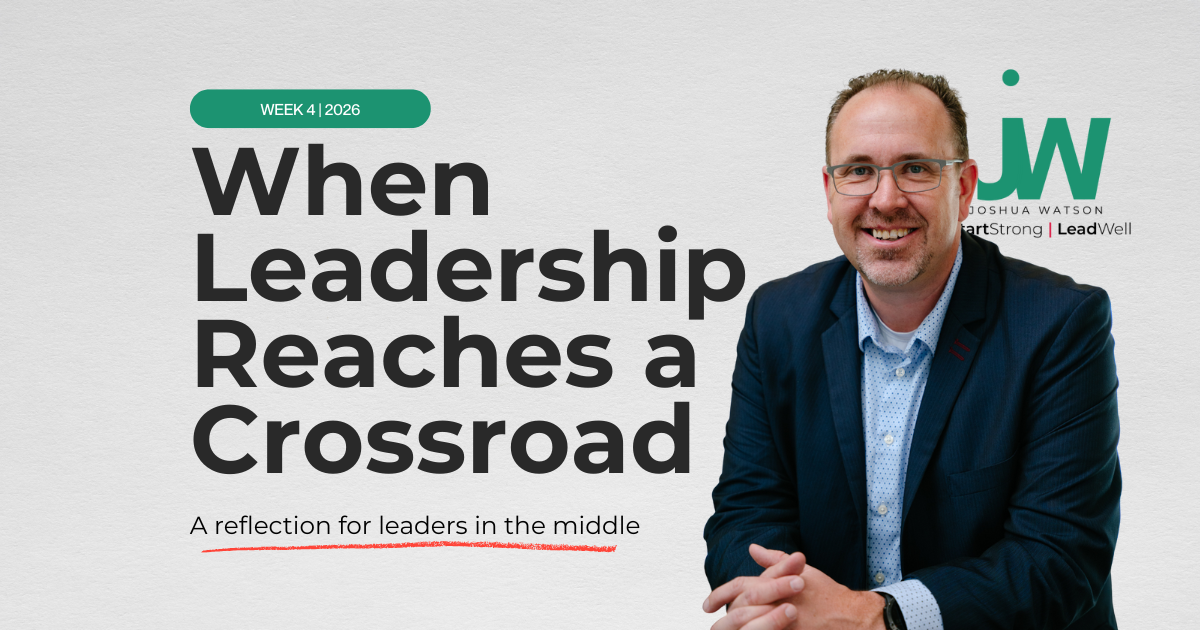
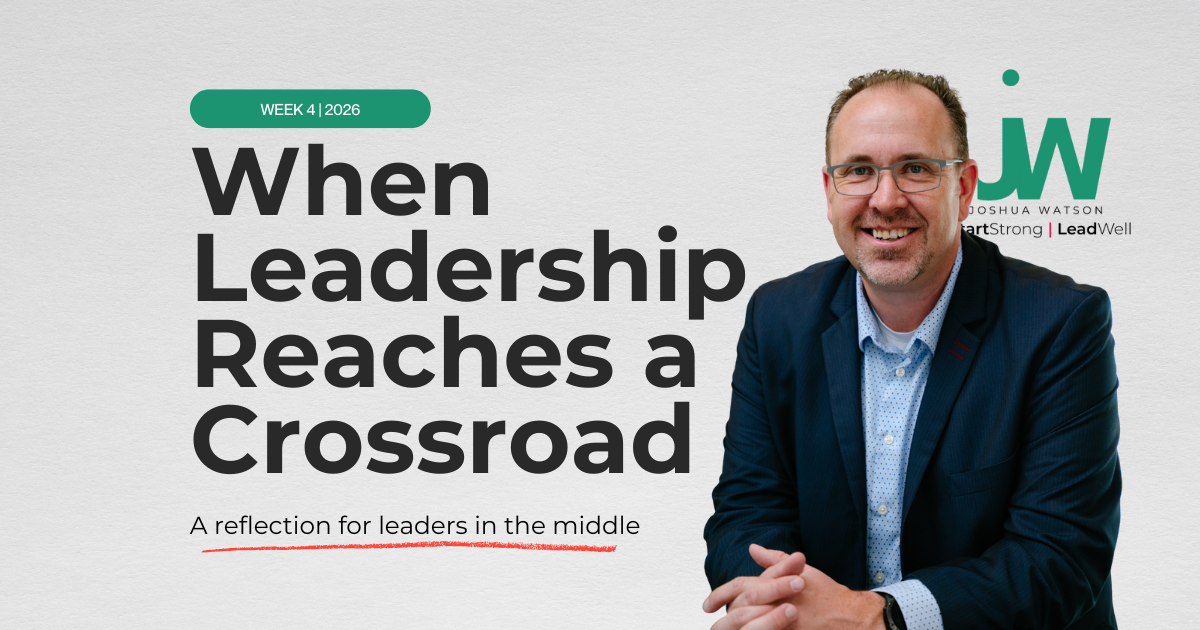
When Leadership Reaches a Crossroad: A reflection for leaders in the middle
Leadership doesn’t always break down in crisis. Sometimes it slows down in quiet questions you can’t ignore anymore. A reflection for leaders navigating the tension between faithfulness, consistency, and calling.
I love leadership — because I love helping leaders.
Not the spotlight version of leadership. Not the polished, platform-driven kind. I love leadership because I love seeing people thrive. I love helping leaders carry responsibility with clarity, courage, and faithfulness — especially when no one is applauding.
That desire didn’t start with a brand or a content plan. Start Strong | Lead Well wasn’t something I set out to “build.” It emerged naturally from who I am and how I’m wired. I’ve learned something about myself over time: if I’m not positioned to help others, I’m not fulfilled. My purpose is tied to seeing people grow — spiritually, emotionally, relationally, and as leaders.
My life motto reflects that: So Others May Live.
That’s the heart behind this space.
How This Started (and Why I’m Reflecting Now)
By most standards, Start Strong | Lead Well is still very new. I began sharing these weekly reflections last year — not as a finished product, but as an offering. An experiment. A discipline of reflection meant to help leaders begin their week grounded and lead it well.
And because it’s new — and still emerging — this feels like the right time to pause and reflect.
That’s something leaders should do, especially early in a journey.
Reflection isn’t hesitation.
Re-examination isn’t weakness.
Sometimes it’s wisdom.
The Quiet Questions That Don’t Go Away
Leadership doesn’t always break down in crisis. Sometimes it slows down in quiet questions you can’t ignore anymore.
There comes a point when continuing the same way starts to feel less faithful than re-examining why you began in the first place.
This isn’t burnout.
It isn’t quitting.
It isn’t a lack of discipline.
It’s leadership pausing long enough to tell the truth.
The Question Beneath the Questions
If I’m honest, there’s a deeper question underneath all of this — one I’ve wrestled with privately for a while:
Am I helping leaders merely consume encouragement… or helping them carry leadership differently?
There are countless leadership voices online. Many are sharper, louder, more prolific, or more established. If Start Strong | Lead Well were to stop tomorrow, the internet wouldn’t notice. The algorithm would move on. Content would keep flowing.
And that realization isn’t discouraging — it’s clarifying.
Because this space was never meant to chase attention. It was meant to serve leaders.
Leading From the Middle
I deeply respect leaders who shape thinking through books and platforms. Their work matters. Their influence has shaped me, and I’m grateful for the mentorship they provide from a distance through their words and teaching.
But most of my leadership life hasn’t been lived on stages.
It’s been lived in the middle.
No bravado.
No gloss or glamour.
No spotlight.
Just responsibility. Day after day.
Reporting up. Caring down. Managing pressure. Solving problems. Navigating tension. Showing up for a team. Being present for a family. Answering to a boss. Carrying weight quietly.
And I believe there are leaders who need reflections from that place too — from the middle, where leadership is lived more than it is explained.
Not the Many — the One
Leadership isn’t always about reaching the many.
Sometimes it’s about being faithful to the one who needs encouragement right now.
That idea is deeply rooted in my faith. Jesus spoke about leaving the ninety-nine to go after the one — not because the many didn’t matter, but because the one did.
That’s something I’m realizing more clearly about Start Strong | Lead Well.
I’m not trying to go viral.
I’m not chasing scale.
I’m not building for clicks, likes, or applause.
I’m writing for the one leader who’s tired but still faithful.
For the one who feels the tension but keeps showing up.
For the one who needs clarity, not noise.
If that’s a small group, that’s okay.
Faithfulness has never required an audience.
Why I’m Sharing This
I’m not writing this to resolve the tension — but to name it honestly.
Because leaders everywhere are navigating similar crossroads. Deciding whether to continue, adjust, refine, or release. Wondering whether consistency is still aligned with calling. Asking whether what they’re building is truly serving others.
These are good questions.
And leaders don’t need more answers shouted at them. They need space to reflect.
That’s what this post is — and what I hope Start Strong | Lead Well continues to be: a quiet place for leaders in the middle to think clearly, lead faithfully, and remember why they began.
If this tension feels familiar, you’re not alone.
And you’re welcome here.
Why Leadership Is Shaped Early: Setting the Tone for the Year Ahead
Leadership isn’t shaped by one big moment. It’s shaped by what we normalize early. A reflection on why tone, alignment, and foundation matter more than momentum.
There’s a subtle danger that comes with the start of a new year.
Not burnout.
Not apathy.
Momentum.
Momentum feels productive. It feels energizing. It gives the illusion of progress. But momentum, by itself, is not direction. And too often, leaders confuse movement with intentionality.
I’ve entered new years before already in motion—meetings on the calendar, goals in mind, responsibilities waiting. Everything felt urgent. Everything felt necessary. Yet somewhere along the way, I realized I never actually stopped long enough to choose how I wanted to lead that year. I was moving quickly, but I hadn’t set the tone.
Leadership doesn’t usually unravel in dramatic moments. It drifts quietly—through what we tolerate, what we rush past, and what we normalize early.
Momentum Is Not the Same as Intention
There’s nothing inherently wrong with momentum. In fact, leaders need it. But momentum without intention often produces activity without alignment.
You can build quickly and still build poorly.
Early in the year, momentum has a way of masking misalignment. Everything feels fresh. Energy is high. Optimism is strong. But if the foundation is off—even slightly—that misalignment compounds over time.
Leadership isn’t shaped by one defining decision. It’s shaped by the small, early patterns that quietly become normal. What you allow in January becomes what you manage in June. What you excuse early becomes what you resent later.
Tone forms quietly.
Tone Forms Before You Realize It
Tone isn’t set in mission statements or kickoff meetings. It’s set in what you reinforce when no one is watching.
It’s set by:
The conversations you delay
The behaviors you overlook
The pace you model
The standards you quietly relax
Leaders often assume they’ll “address it later.” But later rarely arrives without cost. By the time something feels urgent, it’s usually already entrenched.
What you normalize early doesn’t stay small. It multiplies.
Early Patterns Matter More Than Big Moments
Leadership culture is not built through one big moment of clarity. It’s built through repeated patterns that slowly harden into expectation.
That’s why early decisions matter so much—not because they’re dramatic, but because they’re formative.
The tone you set at the beginning of the year quietly answers questions your team may never ask out loud:
Is excellence expected, or just effort?
Is rest valued, or only output?
Is alignment more important than speed?
Is character non-negotiable, or situational?
These answers are rarely spoken. They’re observed.
Creating the Future You Actually Want
Peter Drucker famously said, “The best way to predict the future is to create it.”
That creation doesn’t happen through vision alone. It happens through tone.
Tone creates direction.
If leaders want a different outcome at the end of the year, they must be willing to shape different patterns at the beginning. Otherwise, the future simply becomes a faster version of the past.
This requires restraint. It requires intentional pauses when momentum begs you to accelerate. And it requires humility—the willingness to slow down long enough to ask uncomfortable questions about alignment.
A Scriptural Lens on Foundation
Scripture speaks directly to this idea of early alignment and foundation. Psalm 127:1 reminds us:
“Unless the Lord builds the house, those who build it labor in vain.
Unless the Lord watches over the city, the watchman stays awake in vain.”
— Psalm 127:1, (ESV)
This isn’t a rejection of effort. It’s a warning about misplaced confidence.
You can build tirelessly. You can plan strategically. You can work relentlessly. And still labor in vain if alignment is missing.
For leaders, this verse isn’t about withdrawing from responsibility—it’s about ordering it. It’s about ensuring that what we’re building is anchored to the right foundation before momentum takes over. For Christians, that anchor is Jesus Christ. We don’t build without Him.
Activity vs. Alignment
Leadership often rewards activity. Alignment requires patience.
Activity feels measurable. Alignment feels slower. But alignment is what sustains leadership when pressure increases.
You can:
Build quickly… or build wisely
Move fast… or move aligned
Gain momentum… or establish direction
The best leaders resist the false urgency of early momentum long enough to choose wisely.
Pause Before Speed
Before the year gains more momentum, there’s value in slowing down just enough to choose the tone.
Ask yourself:
What am I allowing right now that I don’t want normalized?
What pace am I modeling?
What standards am I quietly communicating?
What foundation am I building on?
These questions don’t stall leadership. They strengthen it.
Reflection
Leadership doesn’t drift all at once. It drifts early.
What you allow, prioritize, and tolerate quietly sets the tone for everything that follows. Before the calendar fills and the pace accelerates, choose the tone you want to live with—not just this month, but all year.

What Are You Creating in 2026?
Leadership doesn’t start with strategy—it starts with creation. As you step into 2026, consider what kind of environment you are intentionally creating for your team to thrive.

What Are You Creating in 2026?
The opening weeks of a new year tend to pull leaders toward planning.
Goals. Strategies. Metrics. Initiatives.
None of those are bad things. But they are rarely where leadership actually begins.
Before there was a plan, before there was a command, before there was even a person to lead, there was creation.
Genesis 1:1 tells us, “In the beginning, God created the heavens and the earth.”
That single sentence doesn’t try to explain leadership. It simply reveals something about the nature of God—and, by extension, something about the nature of leadership itself. Leadership begins with intentional creation.
God didn’t start by giving instructions.
He started by making space.
Creation Before Command
One of the most overlooked leadership mistakes is assuming that clarity, motivation, or productivity should come first. In reality, those things emerge after something has already been created.
Before anything could grow, there had to be an environment where growth was possible. Before there could be purpose, there had to be order. Before there could be movement, there had to be space.
That’s true in creation—and it’s true in leadership.
Whether we realize it or not, leaders are always creating something. The question isn’t if you’re creating. It’s what you’re creating.
You’re creating culture.
You’re creating expectations.
You’re creating pace.
You’re creating emotional tone.
You’re creating space—or pressure.
Sometimes all at once.
Creativity Isn’t About Being Artistic
When we hear the word “create,” many leaders instinctively disqualify themselves.
“I’m not creative.”
“I’m not artistic.”
“That’s not really my gift set.”
But leadership creativity isn’t about imagination or innovation in the traditional sense.
It’s about design.
It’s about intentionally shaping the environment your team operates in—often through decisions that look small on the surface but carry significant weight over time.
You don’t need to be artistic to create clarity.
You don’t need to be imaginative to create rhythm.
You don’t need to be inspirational to create space.
You just need to be intentional.
The Environment Is the Message
Most leaders spend a lot of energy communicating expectations. Far fewer stop to consider the environment those expectations live in.
If a leader says, “We value excellence,” but the environment rewards speed over quality, the environment wins.
If a leader says, “We want people to grow,” but there’s no margin to learn or fail, the environment wins.
If a leader says, “We care about our people,” but the pace is relentless and unpredictable, the environment wins.
Creation always speaks louder than intention.
The systems you build, the rhythms you establish, and the space you allow communicate far more than any speech, meeting, or email ever could.
A Pause Worth Taking
As you move into 2026, before you finalize plans or launch initiatives, it’s worth slowing down long enough to ask a more foundational question:
What am I intentionally creating for my team to thrive?
Not what are you fixing.
Not what are you reacting to.
Not what are you pushing harder.
What are you creating?
A Few Questions to Sit With
Not as a checklist. Not as a framework. Simply as prompts.
What have I created that helps my team know what matters most?
What rhythms have I created that shape how work actually gets done?
Where have I created space for people to think, grow, or recover?
What kind of emotional or relational environment have I created?
Where have I created ownership instead of dependency?
Even sitting with one of these honestly can be a meaningful starting point.
One Small, Intentional Step
You don’t need to redesign everything at once.
This week, choose one thing to create intentionally.
Leadership rarely changes through grand gestures. It changes through thoughtful creation, repeated over time.
Beginning Again
Genesis doesn’t begin with activity.
It begins with intention.
As leaders, we often feel pressure to do more. But sometimes the most faithful and effective leadership move is to pause long enough to create the conditions where others can truly flourish.
As you step into this year, consider:
What are you creating for your team to thrive in 2026?