
IDENTITY BEFORE INFLUENCE
When identity is unclear, leaders manage perception instead of responsibility. Courage comes first—then clarity. This lesson applies anywhere you lead.
A reflection on leadership, approval, and learning to lead from the right place
There was a season early in my leadership journey when I lost myself.
At the time, I didn’t realize that’s what was happening. I would’ve told you I was just trying to learn, grow, and find my footing. But looking back, I can see it more clearly now.
It happened early in my tenure as a senior pastor, shortly after we planted our church. I was longing for acceptance and assurance from my peers — leaders I respected, leaders I wanted to learn from, leaders I hoped would see something in me.
It didn’t come easily.
More often than not, I found myself on the outside looking in. Hoping to be included, but not invited. Invited, but feeling like the fifth wheel once I arrived. Always aware of where I stood — or where I thought I stood — in the room.
And slowly, almost imperceptibly, something shifted.
I began striving to be who I thought everyone else wanted me to be. I adjusted my tone. I second-guessed my instincts. I tried to fit into molds that weren’t mine to carry. In the process, I lost sight of my purpose and who God had actually called me to be.
It was painful.
But it was also formative.
Because that season taught me a leadership lesson I’ve carried ever since: when approval becomes the focus, identity quietly erodes.
When Attention Is Misplaced
What I didn’t realize at the time was that my attention was aimed at the wrong target.
I wasn’t driven by arrogance or ego. I was driven by insecurity — by a need to be liked, to belong, to feel validated in the space I had been called to lead.
And when that becomes the driver, leadership suffers.
When identity is unclear, leaders begin managing perception instead of responsibility. Clarity gets softened. Hard conversations get delayed. Decisions get filtered through how they might be received rather than whether they’re right.
Leadership becomes exhausting — not because the work is too hard, but because it’s being carried from the wrong place.
That lesson isn’t unique to ministry.
The context for me happened to be pastoral leadership, but the dynamic shows up everywhere — in boardrooms, project teams, startups, and organizations of every kind. Wherever leaders feel pressure to prove they belong, the same temptation exists: to lead for approval rather than from conviction.
A Needed Reorientation
I’m grateful for that season now, as uncomfortable as it was, because it eventually forced a shift.
At some point, I realized I couldn’t keep chasing acceptance without losing myself entirely. So I stopped trying to appease the masses and refocused my energy on doing what I knew I was called to do — faithfully, consistently, and to the best of my ability.
When that shift happened, things began to change.
My decision-making became clearer.
My leadership became more courageous.
My consistency improved.
Not because I suddenly became fearless — but because I was no longer trying to impress people to earn a seat at a table. I stopped mimicking and started leading. I stopped trying to force myself into spaces that required me to be someone else.
Identity realigned.
Leadership followed.
Scripture Brings the Question Into Focus
The apostle Paul names this tension with striking clarity in his letter to the Galatians:
“For am I now seeking the approval of man, or of God? Or am I trying to please man? If I were still trying to please man, I would not be a servant of Christ.”
— Galatians 1:10 (ESV)
Paul isn’t rejecting people.
He’s clarifying allegiance.
He understands something leaders often learn the hard way: when too many voices define us, conviction weakens. And when conviction weakens, leadership loses its footing.
Care for people is essential.
But people were never meant to be the source of a leader’s identity.
Courage Comes First
One of the most helpful leadership insights I’ve come back to over the years comes from Brené Brown. In Daring Greatly, she reminds us that courage precedes confidence.
Not the other way around.
Waiting to feel confident before acting is a trap — especially for leaders. Confidence doesn’t arrive first; it’s built through courageous action taken while uncertainty is still present.
That was true for me.
Clarity didn’t come before courage. Courage came first — the courage to stop performing, to stop proving, and to start leading from a settled place.
And as courage took root, confidence followed naturally.
Identity Before Influence
Here’s what I know now that I didn’t know then:
What you lead from matters more than how many people you lead.
If approval is the driver, leadership becomes fragile.
If insecurity is underneath it all, influence feels unstable.
But when identity is anchored — not in performance, not in popularity, not in perception — leadership carries a different weight. A steadier presence. A quieter confidence.
Not because everything is easy.
But because leadership is no longer divided.
A Question Worth Sitting With
So here’s the question I’ve been sitting with this week — and maybe it’s one worth sitting with too:
Are you leading from conviction — or from the need to be approved?
Not to judge yourself.
Not to fix everything overnight.
Just to notice.
Because leadership clarity doesn’t start with influence.
It starts with identity.
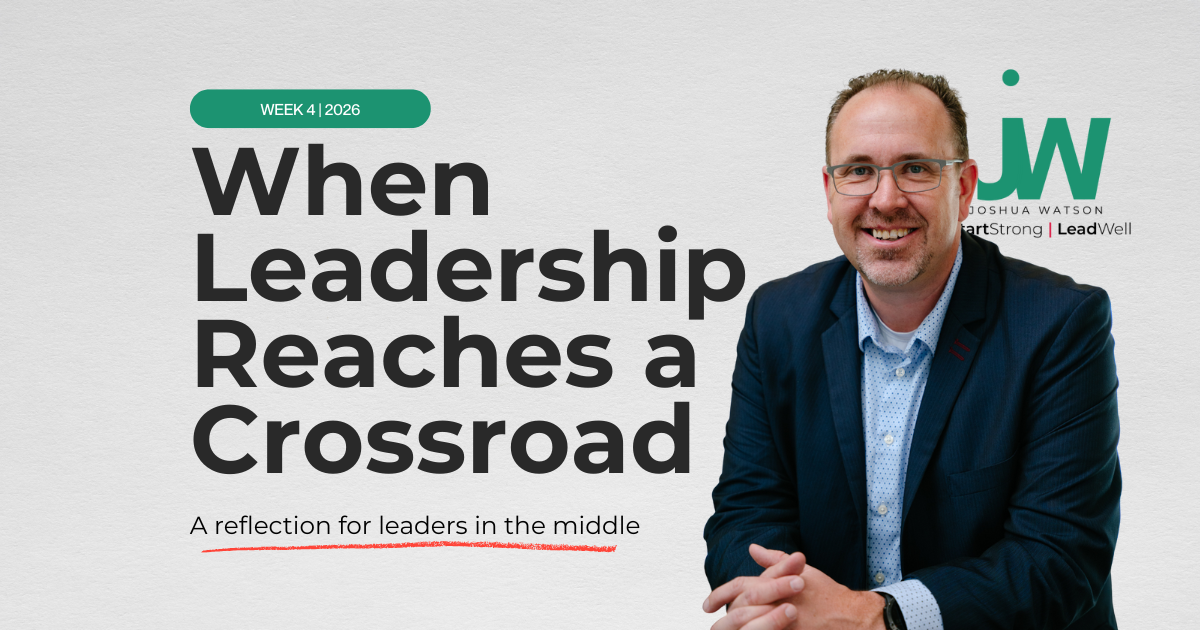
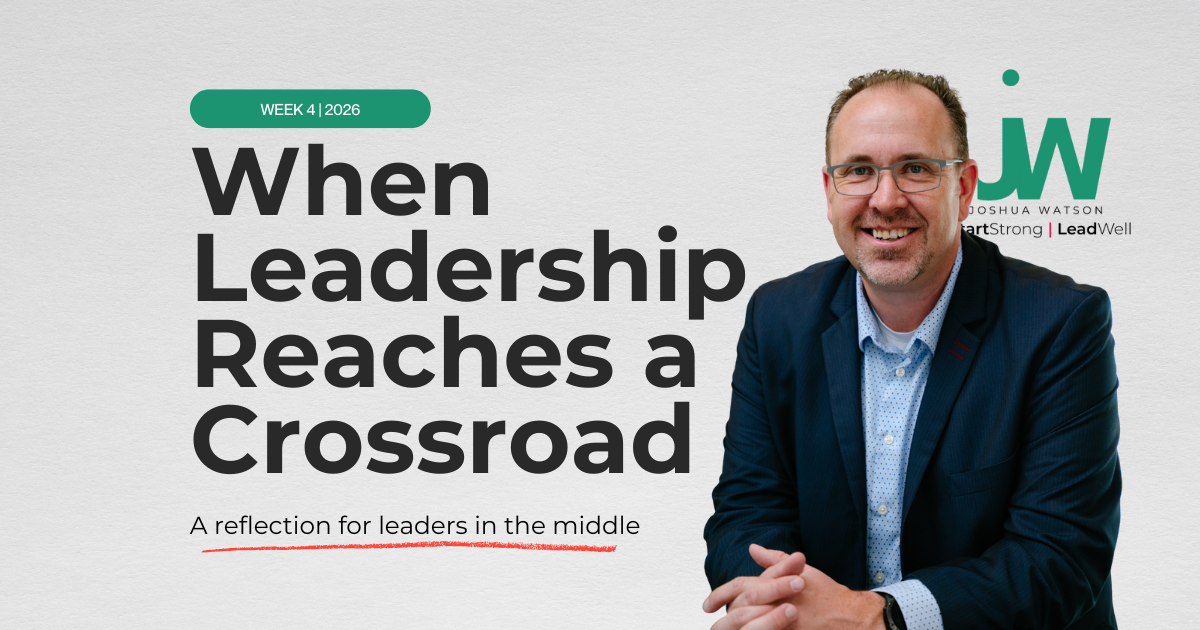
When Leadership Reaches a Crossroad: A reflection for leaders in the middle
Leadership doesn’t always break down in crisis. Sometimes it slows down in quiet questions you can’t ignore anymore. A reflection for leaders navigating the tension between faithfulness, consistency, and calling.
I love leadership — because I love helping leaders.
Not the spotlight version of leadership. Not the polished, platform-driven kind. I love leadership because I love seeing people thrive. I love helping leaders carry responsibility with clarity, courage, and faithfulness — especially when no one is applauding.
That desire didn’t start with a brand or a content plan. Start Strong | Lead Well wasn’t something I set out to “build.” It emerged naturally from who I am and how I’m wired. I’ve learned something about myself over time: if I’m not positioned to help others, I’m not fulfilled. My purpose is tied to seeing people grow — spiritually, emotionally, relationally, and as leaders.
My life motto reflects that: So Others May Live.
That’s the heart behind this space.
How This Started (and Why I’m Reflecting Now)
By most standards, Start Strong | Lead Well is still very new. I began sharing these weekly reflections last year — not as a finished product, but as an offering. An experiment. A discipline of reflection meant to help leaders begin their week grounded and lead it well.
And because it’s new — and still emerging — this feels like the right time to pause and reflect.
That’s something leaders should do, especially early in a journey.
Reflection isn’t hesitation.
Re-examination isn’t weakness.
Sometimes it’s wisdom.
The Quiet Questions That Don’t Go Away
Leadership doesn’t always break down in crisis. Sometimes it slows down in quiet questions you can’t ignore anymore.
There comes a point when continuing the same way starts to feel less faithful than re-examining why you began in the first place.
This isn’t burnout.
It isn’t quitting.
It isn’t a lack of discipline.
It’s leadership pausing long enough to tell the truth.
The Question Beneath the Questions
If I’m honest, there’s a deeper question underneath all of this — one I’ve wrestled with privately for a while:
Am I helping leaders merely consume encouragement… or helping them carry leadership differently?
There are countless leadership voices online. Many are sharper, louder, more prolific, or more established. If Start Strong | Lead Well were to stop tomorrow, the internet wouldn’t notice. The algorithm would move on. Content would keep flowing.
And that realization isn’t discouraging — it’s clarifying.
Because this space was never meant to chase attention. It was meant to serve leaders.
Leading From the Middle
I deeply respect leaders who shape thinking through books and platforms. Their work matters. Their influence has shaped me, and I’m grateful for the mentorship they provide from a distance through their words and teaching.
But most of my leadership life hasn’t been lived on stages.
It’s been lived in the middle.
No bravado.
No gloss or glamour.
No spotlight.
Just responsibility. Day after day.
Reporting up. Caring down. Managing pressure. Solving problems. Navigating tension. Showing up for a team. Being present for a family. Answering to a boss. Carrying weight quietly.
And I believe there are leaders who need reflections from that place too — from the middle, where leadership is lived more than it is explained.
Not the Many — the One
Leadership isn’t always about reaching the many.
Sometimes it’s about being faithful to the one who needs encouragement right now.
That idea is deeply rooted in my faith. Jesus spoke about leaving the ninety-nine to go after the one — not because the many didn’t matter, but because the one did.
That’s something I’m realizing more clearly about Start Strong | Lead Well.
I’m not trying to go viral.
I’m not chasing scale.
I’m not building for clicks, likes, or applause.
I’m writing for the one leader who’s tired but still faithful.
For the one who feels the tension but keeps showing up.
For the one who needs clarity, not noise.
If that’s a small group, that’s okay.
Faithfulness has never required an audience.
Why I’m Sharing This
I’m not writing this to resolve the tension — but to name it honestly.
Because leaders everywhere are navigating similar crossroads. Deciding whether to continue, adjust, refine, or release. Wondering whether consistency is still aligned with calling. Asking whether what they’re building is truly serving others.
These are good questions.
And leaders don’t need more answers shouted at them. They need space to reflect.
That’s what this post is — and what I hope Start Strong | Lead Well continues to be: a quiet place for leaders in the middle to think clearly, lead faithfully, and remember why they began.
If this tension feels familiar, you’re not alone.
And you’re welcome here.

Thankfulness Isn’t Just a Gesture — It’s a Force Multiplier
Thankfulness isn’t just polite — it’s powerful. When leaders practice gratitude with intention, they strengthen culture, deepen trust, and empower teams to thrive. This week’s reflection explores how gratitude becomes a force multiplier and offers three practical ways to put it into action.
Week 47 | StartStrong | LeadWell
Thanksgiving has a way of slowing us down long enough to notice what should have mattered all along. It’s a rare pause in the year — a moment when pace gives way to perspective and we’re reminded of something leaders often forget:
Thankfulness isn’t sentimental.
It’s strategic.
In leadership, the pull to produce never stops. There’s always a deadline, a fire, a meeting, a need. Pressure pushes teams to perform — and yes, urgency has its place. But urgency alone can’t build a healthy culture.
Gratitude can.
When leaders practice thankfulness with intention, something powerful happens: stability increases, trust deepens, and people begin to engage from the heart rather than obligation. Appreciation creates conditions where people want to grow, not just where they’re expected to.
Paul’s words in Colossians 3:15 (ESV) illuminate this beautifully:
“And let the peace of Christ rule in your hearts… And be thankful.”
He wasn’t writing about workplace pressure, but the principle still holds. Peace and gratitude go together — and together, they shape the environments we influence.
In a world that moves fast, gratitude slows us down long enough to see the people who move the mission forward.
So how do leaders cultivate gratitude in a meaningful way? Here are three practical, relationally rich practices that cost nothing but intention — and return more than you imagine.
1. Be Specific
A vague “Great job!” rarely inspires.
But specific appreciation? That creates impact.
“Thanks for staying late” becomes:
“Thank you for staying late and keeping the project moving. Your attention to detail made the difference.”
People feel valued when they feel seen.
And when people feel seen, confidence rises — and culture strengthens.
2. Invite Voices
Asking for input is one of the simplest forms of gratitude.
It says far more than, “What do you think?”
It communicates:
“Your perspective matters. What you see matters. You matter.”
Leaders who listen well don’t just gather insight — they build trust.
And trust is the foundation of every strong team.
3. Stay Consistent
Gratitude shouldn't appear only during holidays, recognition days, or annual reviews.
It should show up in:
• quick messages
• hallway conversations
• unexpected acknowledgments
• small check-ins that communicate care
When gratitude becomes a rhythm, it becomes a culture.
Consistency turns appreciation from a moment into a movement.
Where Gratitude Leads Us
Gratitude doesn’t demand more time — it demands intention.
It asks leaders to slow down long enough to notice, appreciate, and affirm the people who make the mission possible.
This week, consider:
Where can you practice gratitude with more clarity?
And how might it strengthen the people you lead?
Because the truth is simple:
The more consistently you practice gratitude, the stronger your leadership becomes.
Week 46 | Strength Zone vs. Comfort Zone
Comfort feels safe—but it never produces growth. The best leaders know where their strengths thrive and where growth begins. John Maxwell once said, “Stay in your strength zone, but continually move out of your comfort zone.” Growth begins where comfort ends.
Where Growth Begins
Leadership is a constant balance between what you do best and what challenges you most.
John Maxwell once said, “Stay in your strength zone, but continually move out of your comfort zone.” That one principle has shaped how I think about growth and how I coach others to lead.
Your strength zone is where your natural talents create the most value. It’s the space where you feel energized, focused, and capable—the work comes naturally, and the results often follow.
But your comfort zone is something different. It’s where those same talents stop growing. Comfort feels safe, but it never produces growth. It protects what was instead of preparing what could be.
The best leaders know how to stay in one and step out of the other.
The Trap of Comfort
It’s easy to drift into maintenance mode—especially when things are working. Teams are stable, systems are smooth, and results are steady. But comfort can quietly dull innovation and initiative.
The truth is: leaders who settle for comfort eventually lose purpose. Leaders who develop their strengths discover greater purpose.
Your comfort zone protects you.
Your strength zone propels you.
The Purpose of Strength
Scripture reminds us,
“To each is given the manifestation of the Spirit for the common good.”
— 1 Corinthians 12:7 (ESV)
Our strengths—both natural and spiritual—were never meant to stay static. They were given to serve. The more you use them, the more they mature and multiply.
If you spend your career only fixing weaknesses, you might achieve competence. But if you invest in the strengths within you, you’ll grow in influence, excellence, and fulfillment.
Growth happens when we stretch what we already do well into new territory.
The Growth Challenge
This week, ask yourself:
Where have I gotten too comfortable?
What step could stretch my strengths again?
Leadership isn’t about staying where it’s safe—it’s about stepping into the stretch that shapes you.
Because growth begins where comfort ends.

Thermostat Leadership: Steady Under Pressure
Leadership isn’t about avoiding pressure—it’s about leading through it with composure and faith. This reflection explores what it means to be a thermostat leader—steady, steadfast, and grounded in peace.
When Pressure Tests Your Leadership
Pressure has a way of revealing what’s really inside us.
Over the past few months, I’ve been leading through one of the most complex and high-stakes projects of my career. Plans shifted. Timelines moved. The outcome looked nothing like what we expected. And yet, in the middle of it all, I saw something powerful taking shape—grit, perseverance, and true leadership rising to the surface.
Those seasons have a way of humbling you. They strip away comfort, test your character, and force you to ask: What kind of leader am I under pressure?
Thermometers vs. Thermostats
Every leader faces a choice in moments like that.
We can be thermometers, simply reflecting the atmosphere around us, or thermostats, intentionally setting it.
A thermometer rises and falls with the environment.
A thermostat regulates the environment with consistency and composure.
The best leaders don’t react to the climate—they reset it.
They bring calm into chaos and confidence into uncertainty.
As author Brian Tracy once said:
“The true test of leadership is how well you function in a crisis.”
Pressure Doesn’t Just Reveal Character — It Refines It
I’ve learned that the true measure of leadership isn’t control—it’s composure.
Anyone can lead when things go right. But when the unexpected happens, leaders are called to steady others by first being steady within themselves.
Pressure doesn’t just reveal character—it refines it.
It shapes endurance. It deepens empathy. It reminds us that leadership is less about holding everything together and more about staying grounded in what matters most.
A Steadfast Spirit
James 1:12 puts it this way:
“Blessed is the man who remains steadfast under trial, for when he has stood the test he will receive the crown of life, which God has promised to those who love him.”
— James 1:12 (ESV)
James wasn’t writing about workplace stress or project deadlines—he was speaking about trials that test our faith. Yet the same steadfast spirit that anchors us in faith can also steady us in leadership.
When our confidence is grounded in God, not outcomes, we can lead with peace even when everything around us feels uncertain.
Lead with Composure
When pressure builds, I’ve learned to pause and ask myself:
Am I mirroring the chaos around me, or modeling the peace within me?
Leadership isn’t about control; it’s about composure.
When we choose to lead from that quiet center—rooted in faith, anchored in peace—we create stability for everyone around us.
Our teams don’t need us to have all the answers; they need us to carry peace into the room.
Set the Temperature
Leadership has never been about avoiding the heat; it’s about standing in it with the kind of faith and steadiness that changes the atmosphere.
Be the thermostat this week.
Set the tone.
Lead with clarity, faith, and steadfast presence.
Because when peace rules in you, it spreads through those you lead.
#StartStrongLeadWell

What’s Your Story? Leading Through Listening
Every person you lead has a story shaping how they work and why they care. This reflection explores how asking one simple question—“What’s your story?”—builds trust, deepens connection, and aligns hearts toward a shared purpose.
One of the most powerful questions a leader can ask is simple yet profound:
“What’s your story?”
Over the years, I’ve learned that question has the power to change relationships, reshape teams, and reveal the heart behind the work we do.
When we take time to listen, we do more than gather information—we build bridges. Every story we hear becomes a bridge we can lead across.
The Power of a Question
When I served as a pastor, I became known for asking that one question. Most of those conversations happened over coffee—just two people sitting down, one cup and one story at a time.
I discovered that when people share their stories, they open the door to their hearts. They share their dreams, fears, values, and faith. And often, what begins as small talk turns into sacred ground.
Jesus said it best:
“Out of the abundance of the heart his mouth speaks.”
— Luke 6:45 (ESV)
If we listen long enough, we begin to hear what fills a person’s heart. Their words reveal what matters most to them—their priorities, their pain, and their purpose.
Good leaders learn to listen that way—not just with their ears, but with discernment.
From the Church to the Marketplace
What I learned in ministry still shapes how I lead today.
Every person on your team has a story shaping how they work and why they care.
If you listen long enough, you’ll always find common ground—a shared value, a familiar struggle, or a common dream. It might take some digging, but it’s always worth the effort.
Listening turns workplaces into communities and coworkers into collaborators.
The Divine Intersection
I call this the Divine Intersection—the place where your story intersects with mine, and together they align with a greater mission and vision.
When stories connect, trust grows. Connection deepens. Collaboration strengthens.
Purpose becomes shared.
That’s the moment leadership becomes more than strategy—it becomes ministry.
Lead People, Not Tasks
Leadership at its best isn’t about directing tasks; it’s about developing people.
And people are shaped by their stories.
The moment you ask, “What’s your story?” you stop leading tasks and start leading hearts.
So, here’s the challenge for this week:
Who’s one person on your team whose story you need to hear?
Because every time we listen with intention, we lead with compassion.
And that’s where trust—and transformation—begin.
#StartStrongLeadWell