
The Dokimazō Filter: Approving What Is Excellent
Most leaders don't struggle because they're unfocused. They struggle because they're surrounded by legitimate, important things all competing for finite capacity. The Dokimazō Filter gives you three honest questions to cut through the noise and approve what is actually excellent in this season.

I heard something recently that I couldn't shake.
Kevin O'Leary was talking about Steve Jobs — specifically about how Jobs approached his time. Ruthlessly, intentionally, systematically. Every day he identified the three to five things that would actually move the needle. Everything else was noise. He ignored it without apology.
And honestly? Part of me respected it.
But then I sat with it a little longer.
Because Steve Jobs also died largely estranged from the people closest to him. A complicated relationship with his daughter. Friendships sacrificed on the altar of output. A legacy that is simultaneously one of the most impressive in modern business history — and a cautionary tale about what happens when prioritization is divorced from wisdom about what actually matters.
Ruthless focus is a tool. But a tool without wisdom about what deserves your focus can build an empire and empty a life at the same time.
That's the harder leadership question. Not just — how do I prioritize?
But — how do I know what's actually worth prioritizing?
Most leaders aren't struggling because they're lazy or unfocused. They're struggling because they're surrounded by legitimate, important things competing for finite capacity. Your team. Your family. Your responsibilities. Your growth. Your health. Your calling.
None of those are bad options. That's exactly what makes it hard.
Greg McKeown put it simply: "If you don't prioritize your life, someone else will."
The danger isn't always distraction. Sometimes the danger is letting the loudest thing — or the most visible thing — determine what gets your best.
Paul understood this tension. Writing to a church he loved — from a prison cell, no less — this is what he prayed over them:
"And it is my prayer that your love may abound more and more, with knowledge and all discernment, so that you may approve what is excellent."
— Philippians 1:9-10 (ESV)
Approve what is excellent.
The Greek word behind approve is dokimazō — a refiner's term. It described the process of testing metal to determine its genuine worth. Not just identifying what's good. Examining what's genuinely excellent — worthy of this season, this capacity, this moment.
Discernment isn't instinct. It's a developed capacity. And it's worth praying for.
So how do you actually do it? How do you stand in the middle of a full life — full calendar, full inbox, full responsibility — with five legitimate things pulling at you simultaneously, and actually decipher what's important and what's just noise?
It's not a clean process. There's no spreadsheet that does this for you. Discernment happens in the tension, not around it. But there are questions worth asking that cut through the noise — not perfectly, but honestly. And honest examination is where clarity usually begins.
Three questions worth sitting with:
What cannot move without real consequence?
Some things, if neglected, don't just pause — they break. These are load-bearing. They don't get set down.
What is important but can survive an intentional pause?
Not everything significant is immediately urgent. Some things are genuinely valuable but seasonally flexible. The operative word is intentional — there's a difference between setting something down with care and just letting it fall.
What am I treating as urgent that isn't actually excellent?
This is the hardest one. Some things feel pressing because they're loud — not because they're worthy. The dokimazōquestion is honest: does this actually hold up under examination? Is it excellent — or just noisy?
Jobs prioritized brilliantly. But the filter he used was almost exclusively output. What will move the product forward. What will change the industry.
The filter Paul prays for is different. It accounts for the whole life — love, relationships, legacy that outlasts a product cycle. It asks not just what moves the needle but what is genuinely excellent when you examine it honestly.
That's the leader worth becoming. Not just ruthlessly focused — but wisely discerning.
Knowing what season you're in. Knowing what's load-bearing. Approving what is actually excellent — and having the clarity and courage to let the rest wait.
Start Strong. Lead Well.
Load-Bearing Leadership: Set Down. Not Abandoned.
Leaders are rarely choosing between what's important and what isn't. We're almost always choosing between multiple important things with limited capacity. This is a reflection on what it means to lead well in a demanding season — and the difference between setting something down and walking away from it.
There's a leadership lesson I didn't plan to learn this year.
I learned it by living it.
For the last several months, I went quiet here. No posts. No reflections. No weekly leadership nuggets showing up in your feed on Monday mornings. And if you noticed — thank you. That actually means something.
Here's what was really happening.
My full-time role demanded everything I had. I was leading a multimillion dollar technology transformation that didn't have margin for distraction. My family needed me present — my boys, my wife Sara, and aging parents who deserved my attention. And somewhere in the middle of all of that, Start Strong | Lead Well had to be set down.
Not abandoned. Set down.
There's a difference — and I think it's one of the most underrated leadership distinctions there is.
Patrick Lencioni once said: "If everything is important, then nothing is."
Leaders are rarely choosing between what's important and what isn't. That would be easy. We're almost always choosing between multiple important things with limited capacity. And the ones who lead well over time aren't the ones who somehow do it all. They're the ones who know what season they're in — and steward their capacity accordingly.
"There is a time for everything, and a season for every activity under the heavens." — Ecclesiastes 3:1
Not everything important requires your attention at the same time.
Some things are load-bearing in this season. They cannot be set down without real consequence. Your family. Your primary responsibilities. The people counting on you today.
Other things are important but can survive a pause — if you set them down intentionally rather than just letting them fall.
The key word is intentionally.
I didn't drift away from this. I made a quiet decision to protect what was load-bearing and trust that what mattered would still be here when the season shifted.
It is. And I am.
What I didn't share publicly is that while I was away from posting, I wasn't away from Start Strong | Lead Well. I spent that season building something behind the scenes — developing an executive coaching framework, refining a coaching philosophy, and creating the tools and structure to help leaders do exactly what I just described. Navigate pressure. Protect what matters. Lead with clarity in demanding seasons.
More on that soon.
But for today — just this:
What season are you in right now? What's load-bearing that deserves your full attention? And what important thing might need to be set down — intentionally — so you can carry what actually matters right now?
Faithfulness doesn't always look like output. Sometimes it looks like tending to what's right in front of you and trusting the rest to wait.
Start Strong. Lead Well.
— Joshua

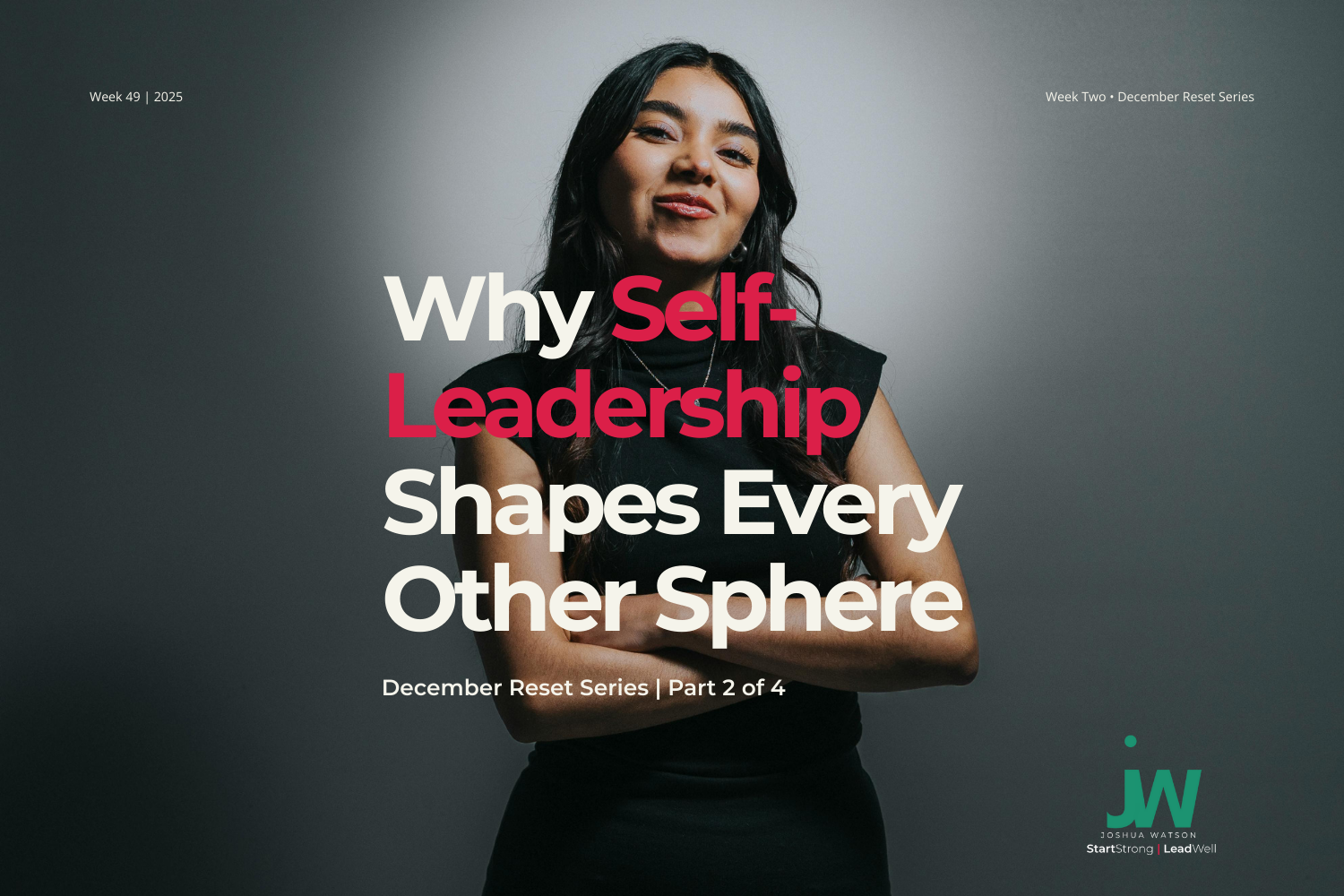
Why Self-Leadership Shapes Every Other Sphere
Self-leadership quietly shapes every other part of your life and influence. In Week 2 of the December Reset, we explore how your habits, rhythms, and daily decisions set the direction for 2026—and why strong leadership begins with the person you’re becoming privately.
December Reset Series • Part 2 of 4
There’s a quiet truth every leader eventually learns:
Some years you drift your way into January… and some years you lead your way into it.
I’ve lived both.
A few years ago, I ran half marathons regularly. I was disciplined, consistent, and focused. But over time, I drifted. What slipped in my physical life eventually showed up everywhere—in my energy, my mindset, and even in the way I led at home and at work.
That season taught me something I needed to remember:
Self-leadership is the foundation of every other kind of leadership.
Not the books you read.
Not the strategies you use.
Not the roles you hold.
Your private patterns—your habits, inputs, rhythms, and boundaries—shape the person who shows up publicly.
And drift?
Drift never stays in one area.
Strength doesn’t either.
Why January Isn’t the Beginning
For most people, the new year starts in January.
But for a leader, the new year begins long before the calendar turns.
Your intentions, your energy, your focus, and your disciplines in December quietly set your trajectory for the year ahead. If you’re not leading yourself well now, it’s unlikely that flipping a date on a calendar will change that.
That’s why this week of the December Reset Series focuses entirely on the first sphere of leadership:
Lead Myself.
Because everything else—
how you lead your family,
how you lead your team,
how you influence your world—
is shaped by the person you are becoming privately.
Proverbs 25:28 puts it this way:
“A man without self-control is like a city broken into and left without walls.” (ESV)
Self-control is not about restriction.
It’s about protection.
Strength. Stability. Clarity.
It builds the walls that support every other part of life.
Consistency Over Intensity
Most leaders overestimate the power of big moments and underestimate the power of small, daily ones.
A ten-minute habit practiced consistently will change your life more than a one-hour burst once a month.
Craig Groeschel says it this way: “Successful people do consistently what others do occasionally.”
And John Maxwell adds: “The toughest person to lead is always yourself.”
Consistency and self-leadership.
Those two themes shape everything.
Three Systems Every Strong Leader Builds
To strengthen your self-leadership, start with three systems:
1. Guard Your Inputs
Your mind eventually reflects whatever you feed it.
Most drift doesn’t begin with a major decision; it begins with subtle inputs we barely notice. What we watch, what we listen to, who we spend time with, and even the internal conversations we entertain—all of it shapes our thinking more than we realize.
Strong self-leadership starts with paying attention to the “gateway” of your life. Just like poor nutrition eventually weakens the body, poor inputs eventually weaken your leadership. The opposite is also true: when you feed your mind with truth, wisdom, stillness, and clarity, your leadership gains strength from the inside out.
Guarding your inputs isn’t about withdrawing from the world.
It’s about choosing what forms you.
2. Build Daily Rhythms
Small habits compound over time. The right ones change everything.
Most leaders underestimate the power of rhythm. We want breakthrough moments, but God often shapes us through steady, quiet practices done faithfully over time. A ten-minute reading habit, a short daily prayer, a nightly reflection, a morning walk—these don’t look dramatic, but they build spiritual, emotional, and mental muscle.
Daily rhythms carry us when motivation dips.
They keep us aligned when life gets loud.
They remind us who we are becoming.
Great leadership isn’t created in the big moments; it’s revealed in them.
But it’s built in the ordinary ones.
3. Stay Accountable
Isolation weakens leaders. Partnership strengthens them.
You can be incredibly gifted and still get stuck if you lead alone. Every leader has blind spots—places we don’t see clearly or drift more easily.
Accountability isn’t about people policing your life.
It’s about people supporting your growth.
The right relationships do three things:
They remind you of your commitments.
They help you see what you can’t see.
They strengthen you when you feel discouraged or unfocused.
Isolation creates drift.
Relationship creates traction.
If you want to grow in self-leadership, don’t do it alone. Invite trusted people into the journey.
A Quiet Direction for the Year Ahead
As you pay attention to how you lead yourself, you’ll also begin noticing themes—words, ideas, invitations from God—that may shape your One Word for 2026.
We’ll explore that more in the weeks ahead, but this is where clarity begins.
Not in January.
Now.
Because strong self-leadership sets the direction for 2026.
Week 2 Study Guide (Free Resource)
To guide your reflection, I created a free study guide designed to help you:
assess your current patterns
identify areas of drift
strengthen key habits and rhythms
build one daily action for the week
begin noticing themes that may shape your One Word for 2026
Click below to download the Week 2 study guide and continue building your 2026 Leadership Guidepost.
Closing Thought
The greatest gift you can give your family, your team, and the people you lead… is a healthy, grounded, consistent you.
Start there.
Lead there.
Build from there.